From Creative Ideas to Interactive Experiences: Meet OU’s Brent Richardson
October 30, 2026 2026-10-30 10:37From Creative Ideas to Interactive Experiences: Meet OU’s Brent Richardson
What happens when a child’s drawing becomes part of a digital exhibit? Or when a piece of paper is transformed into a keepsake coin? At the Children’s Museum of Houston, experiences like these show how art and technology can turn creative ideas into opportunities for hands-on learning.
- Catherine Kerley
For Brent Richardson, an instructor in the University of Oklahoma’s School of Visual Arts, creating these experiences is part of a career that brings together artistic expression, technical problem-solving, and community engagement.
From developing interactive museum exhibits to helping communities explore digital fabrication, Richardson has built a career around making technology accessible, creative, and engaging. Today, he brings those experiences into the classroom through OU Online’s Master of Arts in Art and Technology program.
Bringing Art and Technology to Life Through Interactive Exhibits
At the Children’s Museum of Houston, Richardson helped develop two interactive components for the Mixed Emotion exhibit, giving young visitors opportunities to explore their creativity through technology.
One activity invites children to draw emojis that are scanned and incorporated into a digital display. Another uses a hydraulic press to transform paper responses into keepsake coins visitors can take home.
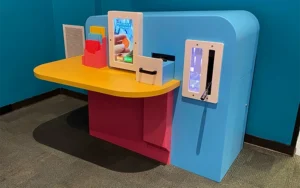
Behind these playful experiences is a combination of programming, electronics, video, 3D printing, and laser cutting. Each component requires creative thinking and technical expertise to move from an initial concept to a functioning exhibit.
For Richardson, projects like these demonstrate how art and technology can work together to create experiences that invite participation rather than passive observation.
They also reflect a career path that began taking shape during his graduate studies at OU.
How an OU Education Opened the Door to Museum Design
Richardson’s interest in art began with craftsmanship and printmaking. While pursuing his MFA in Art, Technology, and Culture at OU, he began incorporating interactive elements and physical computing into his creative work.
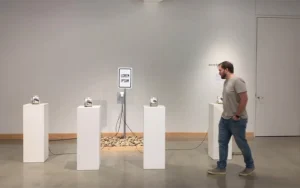
“While I was completing my MFA, a professor connected me with the Sam Noble Oklahoma Museum of Natural History,” Richardson said.
The museum was experiencing problems with some of its interactive components. Because the exhibits relied on technology similar to what Richardson was using in his artwork, he was able to redesign the components for the museum.
The experience introduced him to informal learning environments, where visitors explore concepts through interactive experiences outside traditional classrooms.
It also revealed the value of understanding how different technologies work together.
“My Art and Technology degree gave me experience taking an idea from its initial concept to a complete system,” he said. “I learned to move from design sketches and CAD drawings to software, hardware, and even the construction of the physical enclosure that houses a project.”
The ability to work across creative and technical disciplines became a foundation for his professional career.
Using Creative Technology to Support Communities
Richardson’s work extends beyond museums and galleries into projects that help communities learn, experiment, and solve problems.
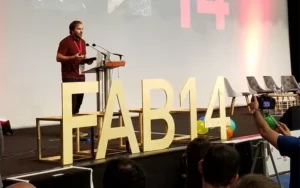
He helped establish Fab Lab Houston, a makerspace where community members could explore digital fabrication and develop hands-on technical skills. He later led the facility, helping participants learn how to use technology to bring their ideas to life.
His projects have also addressed practical community challenges.
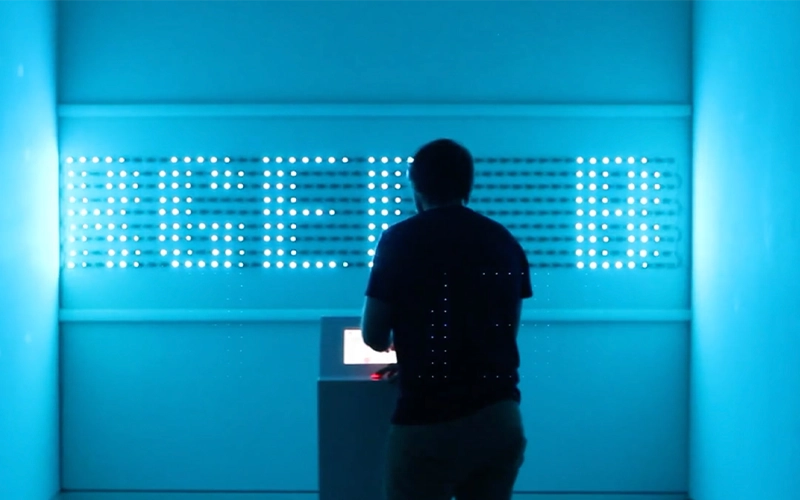
Following Hurricane Harvey, Richardson developed solar-powered water-depth sensors embedded in floating buoys and a physical, robotic LED installation that helped viewers visualize and understand changing water levels on Lake Houston.
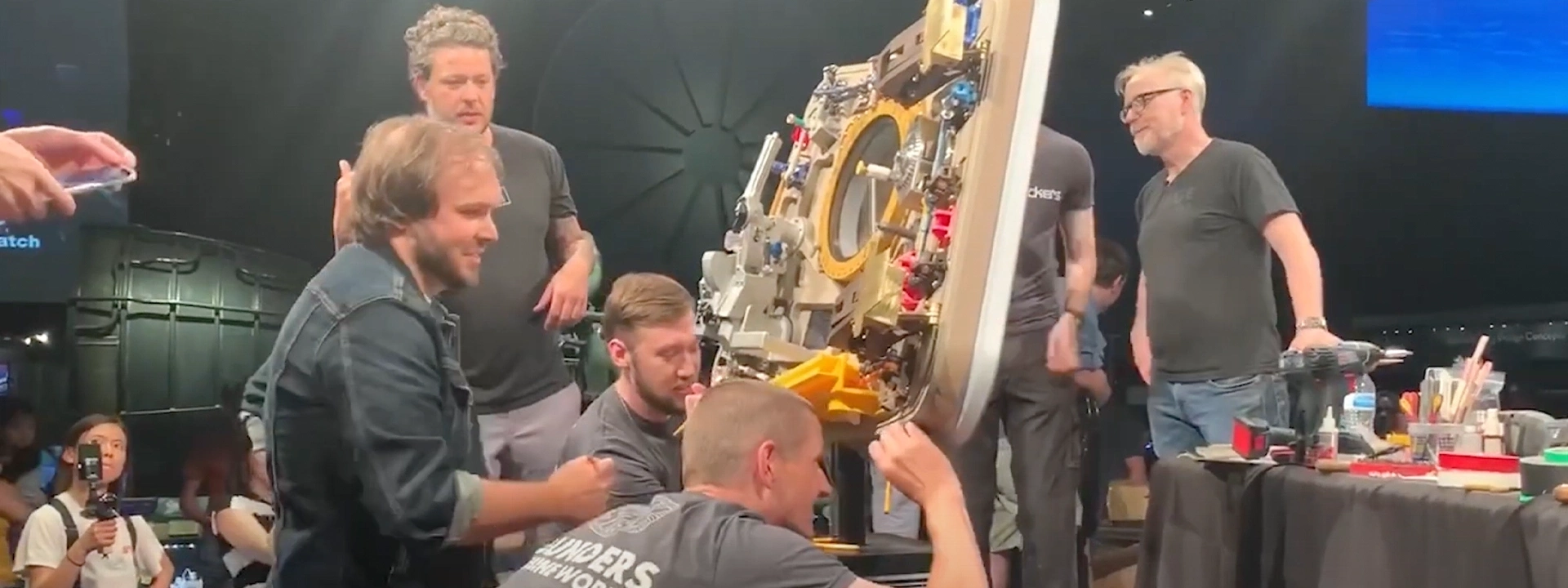
Richardson also contributed to Project Egress, a collaborative effort involving Adam Savage and the Smithsonian’s National Air and Space Museum to recreate the Apollo 11 command module hatch. Using CNC mills, he fabricated the replica’s bottom-middle crank assembly from walnut wood, joining makers and fabrication specialists from across the country.
Although these projects serve different purposes, they share a common thread: using technical knowledge and creative problem-solving to transform ideas into tangible experiences.

Bringing Real-World Creative Experience into the Classroom
As an instructor in the Art and Technology program, Richardson draws on his professional experiences to help students develop their own approaches to creative work.
He teaches Video and Sound Techniques, Moving Image Production, and Creative Coding. He also provides technical guidance for students completing their Professional Project coursework.
His classes emphasize open-ended assignments that encourage students to experiment, solve problems, and pursue ideas that reflect their individual interests.
Rather than focusing exclusively on mastering software or reproducing examples, Richardson encourages students to apply what they learn to original projects.
“My goal is to understand where students want to grow and help them design projects that accelerate their progress toward those goals,” he said.
Students also use portfolio websites to document their work, share knowledge, and demonstrate their developing skills.
Richardson believes this process helps students communicate more than technical proficiency. It also gives them opportunities to show how they approach challenges, apply knowledge in unfamiliar situations, and carry projects from concept to completion.
These abilities are relevant across creative fields, including interactive design, digital media, museum exhibits, and community education.
Encouraging Students to Pursue Their Creative Vision
For prospective students considering an advanced degree in art and technology, Richardson offers advice that goes beyond learning new tools.
He encourages students to think about what they want to create and how their education can help them pursue that vision.
Students with artistic backgrounds may want to strengthen their technical abilities, while those with experience in programming or other technical fields may be interested in exploring new forms of creative expression.
Through OU Online’s MA in Art and Technology program, students can explore creative coding, digital media, and hands-on projects while developing a portfolio of original work.
Richardson encourages prospective students to approach their education with a clear sense of what they hope to accomplish and to see each project as an opportunity to demonstrate their abilities.
“Imagine approaching every class and project as though you might one day sit in front of the hiring team for your dream job and point to that work as evidence of how creative, knowledgeable, and persistent you are,” Richardson said. “I love my career path because no two projects are the same, and there is always a new challenge.”